
How to Paint
Mary Olmstead Johnson (February 7, 1890 – January 22, 1950) was a painter, and my Grandmother. She left behind a cigar box.

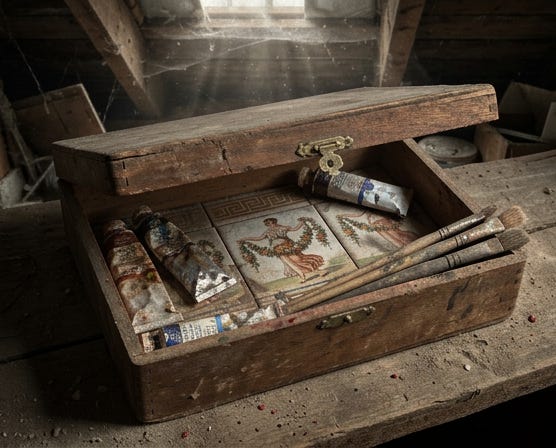
In the basement, on a crossbeam under the upstairs floorboards, next to the old drawer where we hid Indian arrowheads, mysterious coins, and old bathroom fixtures, there was a desiccated cigar box that held the remains of my Grandmother’s oil paints. Three, perhaps four leaky, crinkled tubes and a brush or two, that was all that was left. The box breathed little sighs of linseed oil, and faint bursts of damar varnish, and also contained, of great interest, several painted tiles of a naked woman dancing with a garland.
My grandmother died the year I was born, shortly before my first birthday. She left the following notes at the bottom of the box, folded into little triangles spotted with bits of ultramarine, rose madder, and burnt umber.
“Oil paints are very personal because they drape so seductively, enabling you to continue with your thoughts for quite a while, long after you’ve anguished over it and let it spill out and over to canvas or board. One can paint on anything, on the side of a cow, on a moving train; one can paint on funerals, and even the roof of the town hall. Once the paint has dried, it cannot be returned without disturbing the original intent.
Straight from the tube, oil paint is thick and confident with the faintest glimmer of hubris and a robust dash of peak resistance. It can be diluted with ripe spoils all the way down to translucent gauze.
Let’s start.
First you need:
Brushes: The Purest Interlocking Most Radiant Horsehair Brushes Crisp, Gamy, Porcine Bristle Brushes Searingly White Wobbly Weasel Tail Brushes Flitting Feathered Fitch Brushes The Bluest-Blackest Of Blackest-Bluest Sable Tipped Brushes Heavenly Light Mouse Hair Brushes Master Kolinsky Sable Brushes Several raunchy red sable and assorted tiny brushes made from a baby’s first haircut, especially if you intend to work wet and small.
Oil Paint: Traditional oil paint comes in tubes on rollers — roll them under the bed, or out to the garage. Buy primary colors and bury them in the garden for several seasons, perhaps secondary colors too, and then a range of cheap substitutes.
All will generally live for three or more seasons, but usually the tops die back to the ground each fall. Some artists produce fast-drying oils in 3-inch pots, water-mixable oils in barrels and water buckets, and extra virgin oil paints that are kept hidden and will not tolerate hot, humid summers.
Assemble all your materials on a day without direct sunlight, in a shaded room, or at night under the full moon. What you wear or don’t wear doesn’t matter, it’s how you are being about who you are that counts the most. Paint slowly as if you had all the time in the world, or rush your way through the thing like you do in regular everyday life — either way, what comes out will be what was there in the first place. It’s like having a baby: it will have a clock, and a time, and a life of its very own. Remember that in the end, as in the beginning, you haven’t done it — it, in fact, does you — so just remember to step out of the way when it starts to happen.”
I found out years later that each of my brothers — there were seven of us — had one by one, all found the box, examined the contents, read the notes, and carefully returned it to its hiding place in the dark corner of the basement, on a crossbeam under the upstairs floorboards, next to the old drawer where we hid Indian arrowheads, ancient, melted roman coins, and assorted, discarded bathroom fixtures. None of us ever admitted it was there.
Loved this
Peter, this was wonderful. It felt part memory, part mythology, and part love letter to the creative process itself.
I especially lingered with the idea that we don't ultimately do the work so much as allow ourselves to be changed by it. Thank you for sharing this piece.