
Making Seams Disappear
The returning as something new and vibrant and alive

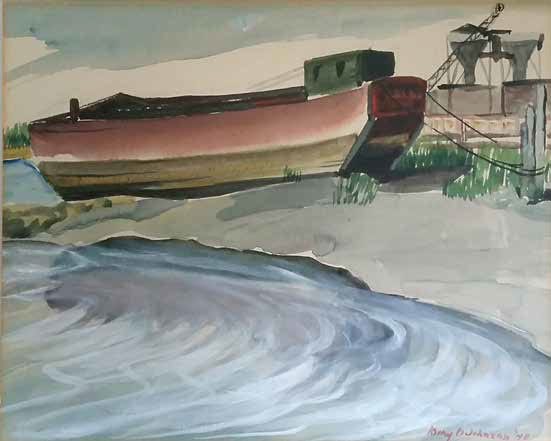
Mary O. Johnson - Title: “Barge at Bar Beach”, Date: c1948
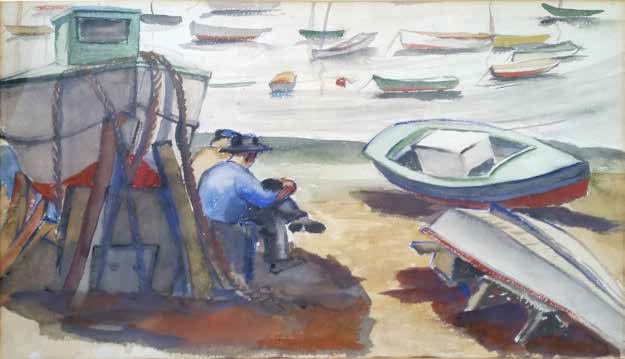
Manhassett Bay, boats in drydock- Medium: Water Color on Paper, Date: c1948
I’m reading Cal Flyn’s Islands of Abandonment. She writes about landscapes humans have abused and walked away from — what the Spanish architect Ignasi de Solà-Morales called terrains vagues: not blighted, not empty, but emotionally charged. Scarred, open, waiting on what was taken and what might return. Flyn’s thesis is quietly radical: “In this cup of nothing is the germ of everything” (Islands of Abandonment). Abandonment doesn’t end life. It creates conditions for latency.
I know these places. I grew up in one.
As a teenaged boy on the Gold Coast of Long Island, Port Washington’s Shore Drive with its popular Bar Beach was circled by what was locally known as the sand pits. Common lore was that the sand built Manhattan. The lore was true. From 1865 to 1989, over 200 million tons of Cow Bay sand was barged from Hempstead Harbor to New York City — 90% of the concrete in the sidewalks, subway tunnels, skyscrapers. Fifty barges a day. Eight hundred immigrant laborers living in barracks on the banks, earning $1.50 for a twelve-hour day in 1910. Death from cave-ins was a constant threat. The mining leveled hundred-foot glacial cliffs to flat gravel pans. What remained were lunar bowls behind Bar Beach — too industrial to be beach, too empty to be town. Off-limits, a little dangerous, totally magnetic. We’d circle them on bikes. You could stand at the edge, look at the Manhattan skyline across the Sound, then turn around and see the hole it came from.
I grew up with my grandmother’s watercolors on the wall. Mary O. Johnson — the O was for Olmsted. She painted on location in 1948, when the sand mining was still running full tilt. One painting: a barge in Hempstead Harbor, low in the water, red hull, a loading tower visible behind it. One of the fifty a day. She didn’t paint the Gatsby mansions on Sands Point. She painted the work. The thing that made the ship go. Another of her paintings was a dry dock — the cove on Manhasset Bay where I’d ride my bike at low tide for steamers that we used to call Piss clams. Two baymen, boats up on blocks, the bay scattered with skiffs. The extraction and the sustenance, side by side. Both framed, both hanging on the wall.
I left Long Island for Manhattan in 1967. After an acceptance to Pratt Institute. First marriage. Leaving the Gold Coast for the Lower East Side, 4th Street between Avenue A and Avenue B. Another terrain vague — 1969, this one made of abandoned lots and burned-out buildings, white flight and landlord neglect.
To make my way, I took a job sheetrock taping a four-story tenement for my landlord. All day I would tape the sheetrock seams, got pretty good at it — the smell of the compound, the white walls, the white tape, the eight-inch knife, the four-inch knife. I would cover the walls with paint in my mind, usually English landscapes, those small tight ones with the lighter highlights overpainted, glazed a thousand times and covered with enough mastic to kill anything. There was light and sound, little kids, junkies and cops. Sirens all day long, people screaming in Spanish, babies crying, the smell of new lumber and the white light of so many people’s lives.
The compound was magic in its own right — as it dried it would color-shift to the exact shade of the sheetrock. Then the sanding: first the handheld vibrating sander, then graduated sheets by hand. Making the seam disappear.
At night I would slowly walk home, taping compound dried and stuck to my clothes and in my hair and on my face. My place was so quiet in contrast. I’d sit on my old oak Murphy chair and think about seams, this incomprehensible world, this pervasive loneliness, this untold, obscure script.
I started painting again. Small canvases, always of shadowy figures, dark and unrecognizable, with erotic clouds piercing an impregnable night sky. The paint was heavy — I would lift it from a plate glass palette like exquisite pieces of broken china and place it delicately on the raw linen. I loved the smell of the linen, always bought the best Belgian cloth I could afford, my place smelled like that: linen, sun-thickened linseed oil, old sticky bottles of stand oil. Glazing works by accumulation — transparent layer over transparent layer, each one altering the tone beneath it. Twenty coats in, the paint is no longer on the surface. The eye goes into it. The seam between flat linen and something that breathes disappears.
One night I painted till four or five in the morning, then took the subway all the way down to Wall Street. Freaky down there — not a soul anywhere, just huge black rats and giant white billowing sheets of newspaper flowing down the street in the dawn breeze. I felt invisible, privileged, as if I were witnessing some singular kind of historical event.
They were the same things, weren’t they? The Belgian linen canvas and the sheetrocked walls and the lunar bowls behind Bar Beach. The desire to regenerate, the seams disappearing, the returning as something new and vibrant and alive.
My mother became the reference librarian at Port Washington Public Library. The same library that holds the Particles of the Past oral histories — the 1981 project that interviewed the sand miners and their families, preserved the names, the clipping files, the records of men buried under dozens of tons of loose sand. She was one of the keepers of that archive. My grandmother had painted the barge. My mother catalogued the history of the sand and I was taping seams in the tenements that sand became.
Flyn writes: “Again — this latency of life. It drifts around us all the time, invisible, like an ether. It’s in the air we breathe, the water we drink. Each breath, each sip, is thick with potential.” That ether was in the sand pits when I circled them as a kid. It was in the tenement on Avenue B. It was in my grandmother’s watercolors. The pits are the Hempstead Harbor Preserve now — 240 acres, over 400 species, more than 20 distinct habitats, documented by naturalist David Jakim over a decade of mapping what came back: breeding deer, fox, heron rookeries, beaver, box turtle, species found nowhere else in the state. Not into what was there before, but into something the extraction made possible by leaving — the way transparent glazes laid over a painting transform the color beneath into something it couldn’t have been alone, rich and interior and alive. The tenement wall took the compound. My paintings took the glaze.
Solà-Morales was right. Terrains vagues aren’t empty. They’re charged with latency. And the art — whether it’s with a brush, an eight-inch mud knife, or time — is making the seam disappear so something new can happen.
“In this cup of nothing is the germ of everything.” — Cal Flyn
I'm reminded of the ending of Ernest Hemingway's novella "The Old Man and the Sea." The protagonist, the old fisherman Santiago, after a difficult struggle with the fish and the sea, asks himself, "Who defeated you, old man?" and answers, "No one. I simply went too far out to sea."
wow.. really nice how what 'is' becomes 'was .. and then back to 'is'.